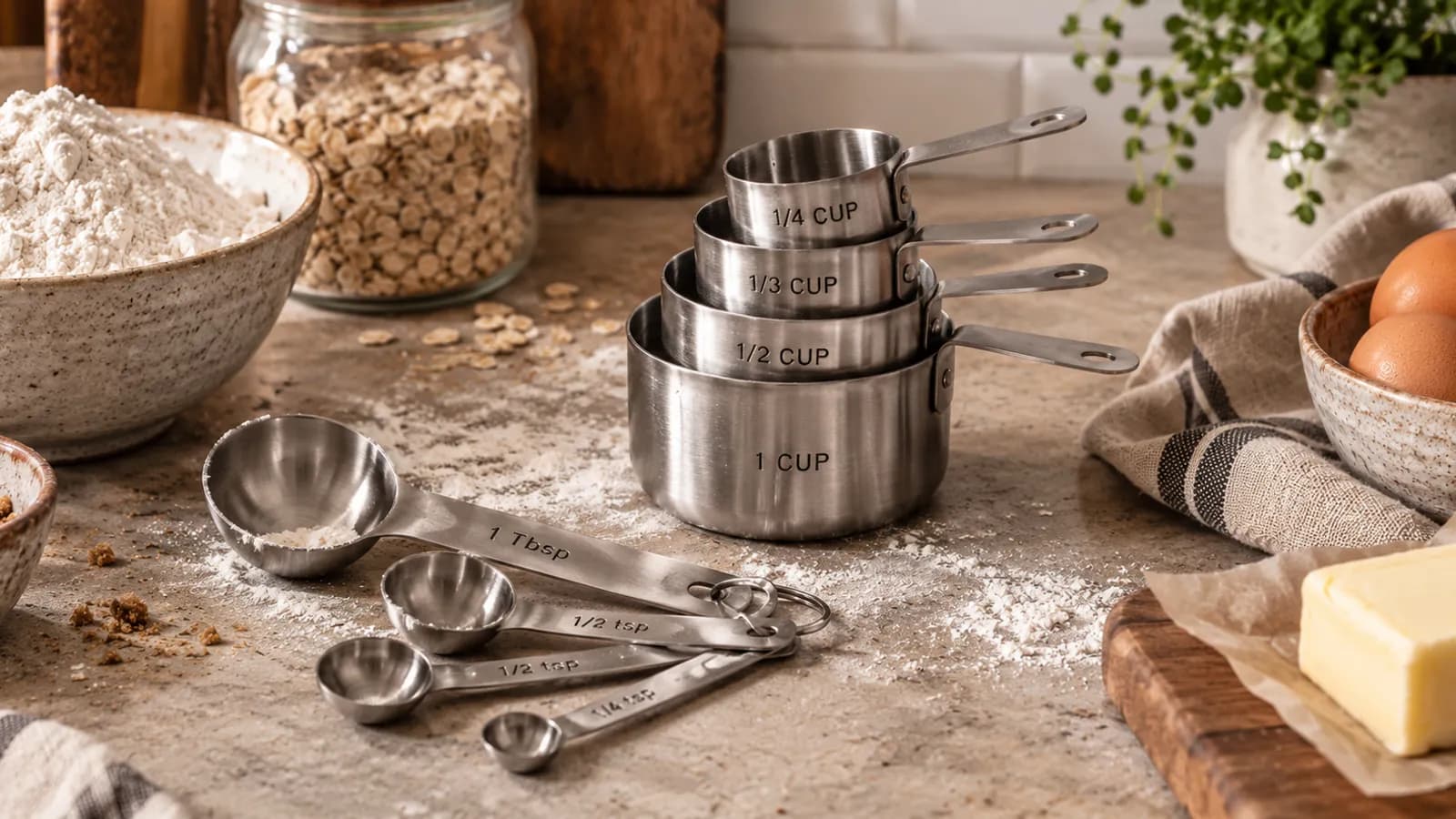
Weights, Volumes and the Cup Problem
Why can one recipe say a cup of flour weighs 120 g and another say 150 g? And is an American cup actually the same size as a South African one? This guide explains the difference between weight and volume.
By Lee Mokonyane · 9 September 2026 · 10 min read
Recipes have their own geography.
American recipes commonly use cups. British recipes favour grams. Australian recipes use metric cups but have an unusual 20 mL tablespoon. South African recipes often mix grams, millilitres, cups and spoons.
Usually this causes little trouble. A slightly generous tablespoon of oil will not ruin a stew.
Baking is less forgiving because a cup measures volume while a gram measures mass. They tell you different things.
What Does a Cup Actually Measure?
A cup tells you how much space an ingredient occupies.
Fill the same cup with flour, sugar, chocolate chips and honey and each ingredient occupies the same volume. Their weights will be very different because their densities and structures differ.
So there is no useful answer to:
How many grams are in a cup?
The ingredient has to be specified.
Typical working conversions might be:
- Plain or cake flour: about 120–130 g per cup
- White sugar: about 195–205 g
- Butter: about 225–230 g
- Chocolate chips: about 165–175 g
- Honey: about 335–345 g
These are reference values rather than universal constants. The cup and measuring convention used by the recipe still matter.
Why Flour Causes So Much Trouble
Flour contains air between its particles and can settle or compact considerably.
One person may loosen the flour, spoon it into a cup and level the surface. Another may push the cup directly into the flour bag and scoop it out.
Both measured one cup. They may have added very different amounts of flour.
Suppose a cake requires three cups.
At 120 g per cup:
3 × 120 g = 360 g flour
At 150 g per cup:
3 × 150 g = 450 g flour
That is 90 g more flour while the eggs, sugar, fat and liquid remain unchanged.
The second cake may be drier, denser or heavier, and the baker may blame the recipe, oven or mixing when the difference began with measurement.
Put 360 g flour on a scale and it remains 360 g regardless of how aerated or compacted it was beforehand.
That repeatability is the main advantage of weighing.
Why Baking Benefits More From Weighing
Cooking often allows adjustment.
A stew can take a little more onion. Stock can be reduced. Seasoning can be corrected after tasting.
Once a cake is in the oven, correcting its ingredient ratios is considerably harder.
Flour, liquid, fat, sugar, eggs and raising agents influence the structure of batters and doughs. Too much flour can make a cake dry or dense. Excess liquid can weaken its structure. Too much raising agent can cause rapid expansion followed by collapse.
Sugar affects more than sweetness too. Depending on the recipe, it can influence moisture, tenderness, spread, browning and texture.
You do not need laboratory precision for every ingredient. Weighing is most useful where variation can materially change the result.
Not Every Cup Is the Same Size
International recipes introduce another problem: cup is not a universal volume.
In South African cooking:
- 1 metric cup = 250 mL
- 1 tablespoon = 15 mL
- 1 teaspoon = 5 mL
South African Department of Basic Education material uses these kitchen equivalents. (Department of Basic Education)
A US customary cup is approximately 236.6 mL. For practical metric kitchen conversions, NIST commonly rounds a US cup to 240 mL. (NIST Publications)
Australian recipes generally use a 250 mL metric cup.
A difference of roughly 10–13 mL in one cup of liquid is unlikely to destroy most recipes. Across several measurements or a scaled recipe, differences accumulate.
Knowing where a recipe was developed can therefore help you interpret its measurements correctly.
Watch the Australian Tablespoon
An Australian tablespoon is 20 mL, rather than the 15 mL tablespoon commonly used in South African and US recipes.
That creates a larger difference than the cup discrepancy.
Three Australian tablespoons equal:
3 × 20 mL = 60 mL
Three standard 15 mL tablespoons equal:
3 × 15 mL = 45 mL
For a garnish, the difference may be irrelevant. For oil, syrup or another ingredient affecting the recipe’s balance, it can matter.
Grams and Millilitres Are Different Too
Grams measure mass.
Millilitres measure volume.
They appear interchangeable with water because, under ordinary kitchen conditions, water has a density close to 1 g per mL.
So approximately:
100 mL water ≈ 100 g
That relationship does not apply to every ingredient.
Oil is less dense than water, so 100 mL weighs less than 100 g.
Honey is denser, so 100 mL weighs considerably more than 100 g.
Density is why volume-to-weight conversions must be ingredient-specific. NIST similarly notes that ingredient density matters when moving between volume and mass measurements. (NIST)
Useful Cup-to-Weight References
When no weight is supplied, these ranges are reasonable working references:
- Plain, cake or all-purpose flour: 120–130 g
- Bread flour: 120–130 g
- White or caster sugar: 195–205 g
- Packed brown sugar: 210–220 g
- Icing sugar: 115–125 g
- Butter: 225–230 g
- Rolled oats: 80–90 g
- Cocoa powder: 80–90 g
- Chocolate chips: 165–175 g
- Honey: 335–345 g
- Vegetable oil: 215–225 g
The ranges are intentional.
Ingredient composition, cup size and measuring method can all affect the result. A conversion chart should therefore be treated as a working reference rather than a definition of the ingredient.
Why Conversion Charts Disagree
Search for the weight of one cup of flour and you may find 120 g, 125 g, 130 g or more.
Different publishers use different standards and measuring methods.
When converting a recipe, use this order:
- Use the weight supplied in the recipe.
- If there is no weight, check whether the recipe author provides a conversion guide.
- Otherwise, use a reliable ingredient-specific conversion.
- Record the quantity that produced the successful result.
If your cake consistently works with 375 g flour, that number is more useful for repeating it than repeatedly converting the original cup measurement.
Avoid Converting a Recipe Twice
Every conversion introduces assumptions and rounding.
A recipe may begin with 250 g flour. Someone converts that into cups using one standard. You then convert their cups back into grams using another chart.
You may not arrive back at 250 g.
Where possible, work from the recipe’s original measurement system. If both systems are supplied, favour the measurements used to develop and test the recipe when that information is available.
Cups and Spoons Still Have a Place
Not every ingredient benefits from weighing.
Volume measurements are convenient for:
- everyday cooking liquids
- vinegar
- small quantities of oil
- sauces and condiments
- vanilla and other extracts
- herbs and spices
- ingredients where small variation will not change the result materially
Small quantities can also be awkward on a domestic scale. A scale that measures only in 1 g increments may be less useful for ¼ teaspoon of spice or a small amount of raising agent than a measuring spoon.
Precision should solve a problem, not create unnecessary work.
What Is Worth Weighing?
In baking, weighing is particularly useful for:
- flour
- sugar
- butter and other fats
- chocolate
- cocoa
- honey and syrups
- oats and nuts in substantial quantities
- larger quantities of other dry ingredients
Weights are also preferable in recipe development because another cook needs to reproduce the same result.
“125 g flour” leaves considerably less room for interpretation than “1 cup flour.”
If You Have to Measure Flour in Cups
When a recipe provides only cups and does not specify a measuring method, spoon and level is a useful default.
- Loosen the flour in its container.
- Spoon it gently into the measuring cup.
- Do not press it down.
- Fill slightly above the rim.
- Level the surface with a straight edge.
Scooping directly from the bag can compact more flour into the cup.
That method is not inherently wrong if the recipe was developed that way. The problem arises when the recipe writer and cook use different methods without knowing it.
Read the Measurement Instructions Carefully
The words around a measurement can change what the recipe means.
1 cup packed brown sugar tells you to compress the sugar into the cup.
1 cup sifted flour usually means sift first and then measure.
1 cup flour, sifted usually means measure first and sift afterwards.
If measuring liquids by volume, use a measuring jug on a flat surface and read it at eye level.
Dry measuring cups are designed to be filled and levelled at the rim.
The measuring method is part of the measurement.
Use the Tare Button on Your Scale
The most useful function on a kitchen scale is tare, sometimes labelled zero.
Place the mixing bowl on the scale and press tare. The display returns to zero, allowing you to weigh the ingredient without including the bowl.
You can tare again before adding the next suitable ingredient.
This is quicker than weighing everything separately and reduces washing up.
Slow down as you approach the target. Removing excess flour is easy when it is alone in a bowl and considerably harder once it is sitting on top of sugar, cocoa and butter.
How to Convert an International Recipe
Do not run the entire ingredient list through one generic conversion.
1. Identify where the recipe comes from. This helps establish which cup and tablespoon system it is likely to use.
2. Use supplied weights first. If cups and grams are both provided, use grams for major baking ingredients.
3. Convert dry ingredients individually. A cup of flour requires a flour conversion; a cup of sugar requires a sugar conversion.
4. Leave liquids in millilitres where practical. If converting volume to weight, use the ingredient’s density rather than assuming every millilitre weighs one gram.
5. Keep tiny measurements sensible. There is little advantage in converting ½ teaspoon vanilla into an awkward decimal weight.
6. Test the recipe. A mathematical conversion has not been validated until the food has actually been made.
7. Save what worked. Record your successful measurements rather than converting them again next time.
Do Not Confuse Accuracy With False Precision
Suppose an old recipe gives one cup of flour and a calculator converts that to:
126.37 g
The decimal places imply accuracy the original measurement never had.
Writing 125 g may be more useful.
Good recipe writing uses enough precision to reproduce the food. More digits do not automatically make a measurement more accurate.
Measure What Matters
A kitchen scale does not make cooking rigid. It removes avoidable variation.
Weigh the flour for a cake and use a teaspoon for the vanilla. Measure bread dough accurately, then learn how properly hydrated dough feels. Record the quantities that work, then use experience to recognise the correct texture.
The principle is simple:
A cup measures volume. A gram measures mass. Converting between them requires knowing what the ingredient is.
Once the important ingredients are measured consistently, a failed recipe is easier to diagnose and a successful one is much easier to repeat.