How Egg Foams Work: Whipping, Peaks and Meringue
Learn what happens when eggs are whipped, how to recognise each peak stage and what makes a foam hold or collapse.
By Lee Mokonyane · 29 September 2026 · 4 min read
How Egg Foams Work: Whipping, Peaks and Meringue
Whisking an egg white can expand it to several times its original volume because its proteins can stabilise thousands of air bubbles. (American Egg Board)
A successful foam depends on creating those bubbles without damaging the protein network that holds them.
What Whipping Does
Egg white is mostly water and protein.
Whisking introduces air and physically unfolds some of those proteins. They collect around the boundary between air and water, creating a film around each bubble.
Continued whisking produces more, smaller bubbles and a finer foam.
The foam still needs to remain flexible. Overwhipping creates an increasingly rigid protein network that can no longer stretch effectively around the bubbles.
The result becomes dry, grainy and eventually unstable.
What the Peak Stages Mean
Peak descriptions are practical indicators of how far the foam has developed.
Foamy: Large bubbles remain visible and the whites are loose.
Soft peaks: The foam is white and holds a peak that folds over.
Medium peaks: Peaks hold more clearly but retain some flexibility.
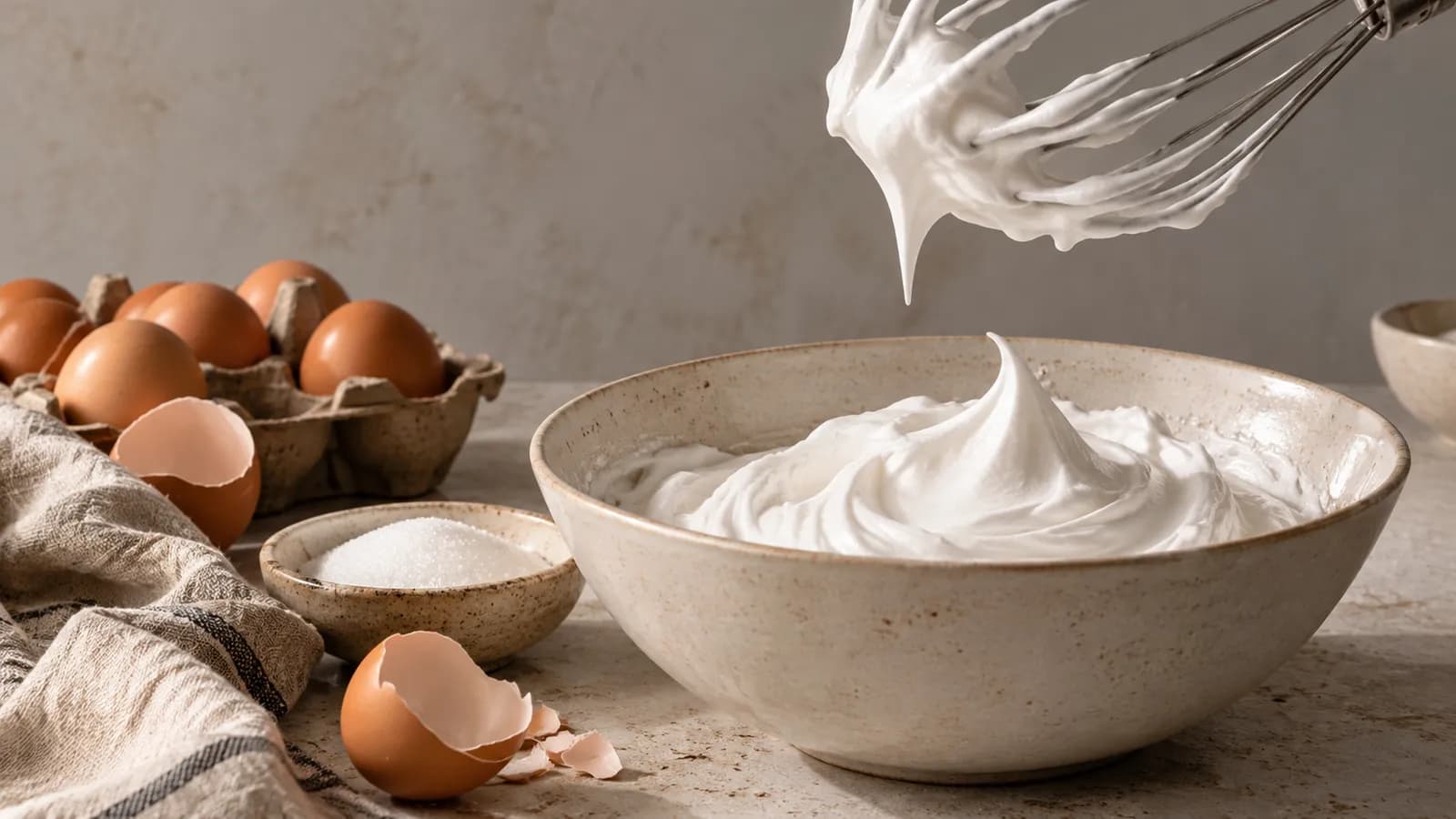
Stiff peaks: Peaks remain upright when the whisk is lifted.
Recipes specify these stages because different applications need different amounts of structure.
Going past stiff peaks does not create a stronger foam indefinitely. Eventually the whites become clumpy and difficult to incorporate.
Why Fat Causes Problems
Egg whites contain virtually no fat, which helps explain their exceptional foaming ability.
Yolk contamination introduces fat that can interfere with the proteins forming stable films around air bubbles.
A tiny trace does not guarantee failure, but clean separation becomes increasingly important when maximum volume and stability are needed.
Use clean, grease-free equipment. Stainless steel and glass are easier to degrease reliably than scratched plastic.
What Acid Does
Cream of tartar, lemon juice and vinegar can stabilise egg-white foam.
Acid changes protein interactions so the network develops more gradually and remains flexible for longer. This gives the foam greater resistance to overwhipping and collapse. (American Egg Board)
Only a small amount is needed.
What Sugar Does
Sugar strengthens a finished meringue but slows foam development.
It dissolves into the water in the egg white and increases the stability of the foam, helping produce the dense, glossy structure expected from meringue.
Adding a large quantity before the whites have developed enough foam can make whipping much slower.
This is why many methods establish the foam first and add sugar gradually.
Why Meringue Can Feel Gritty
Grittiness usually means undissolved sugar remains in the foam.
Finer sugar dissolves more readily. Gradual addition also helps.
For meringues where complete sugar dissolution matters, rub a small amount between your fingers. A gritty feel indicates remaining crystals.
Whole Eggs Can Hold Air Too
Whole eggs cannot produce the same enormous foam as whites, but they can still trap substantial air.
Genoise and similar sponge cakes often whisk whole eggs with sugar until the mixture becomes pale, thick and voluminous.
At ribbon stage, batter falling from the whisk leaves a visible trail on the surface before slowly disappearing.
The incorporated air supplies part of the cake’s eventual volume, so later ingredients need to be folded in without unnecessarily destroying the foam.
French, Swiss and Italian Meringue
The three common methods differ mainly in how sugar and heat are introduced.
French Meringue
Raw egg whites are whipped and sugar is gradually added.
It is the simplest method and is commonly used for baked meringues, pavlova and mixtures that will be folded into another preparation.
Swiss Meringue
Egg whites and sugar are heated together before whipping.
Heating helps dissolve the sugar, producing a fine, glossy foam useful for buttercream and toppings.
Italian Meringue
Hot sugar syrup is streamed into whipping egg whites.
The syrup produces a dense, stable foam useful for buttercream, mousses and toppings.
These methods are not interchangeable in every recipe. Their moisture, stability and handling differ.
Why Egg Foams Collapse
Common causes include:
- grease or significant yolk contamination
- underwhipping
- overwhipping
- adding sugar too quickly
- rough folding
- leaving an unstable foam standing too long
- insufficient final cooking or drying for the recipe
Troubleshooting becomes easier once you identify whether the problem occurred while creating the bubbles, stabilising them or setting the final structure.
That is the entire job of an egg foam.