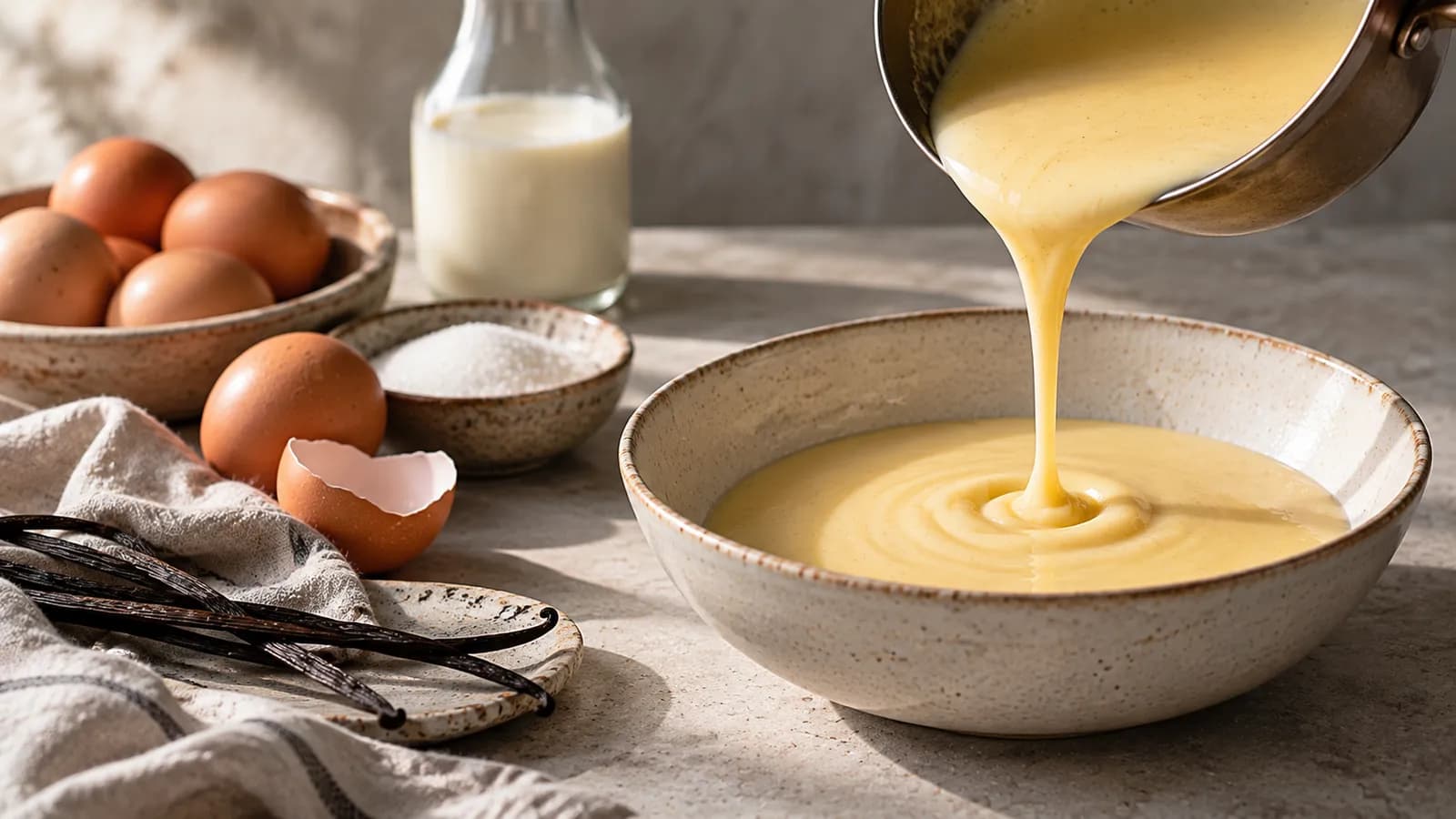
How Eggs Thicken: Custards, Tempering and Coagulation
Why eggs thicken as they heat, how to control that process and what causes custards to curdle.
By Lee Mokonyane · 15 September 2026 · 4 min read
Custard thickens because egg proteins form a network through the surrounding liquid.
Control that network and the result can be silky and barely set. Tighten it too far and the same ingredients become grainy, curdled or watery.
How Egg Thickening Works
Heat unfolds egg proteins. The unfolded proteins begin connecting with one another, creating a network that traps water.
This is coagulation. (American Egg Board)
Egg whites generally coagulate around 62–65°C and yolks around 65–70°C when considered on their own. A custard contains other ingredients, so its behaviour cannot be predicted from those numbers alone. (American Egg Board)
Sugar, dilution, acid and starch can all change how proteins interact and when noticeable thickening occurs.
Why Custard Needs Controlled Heat
Proteins continue forming bonds as heating continues.
For custard, enough bonding creates body. Too much creates a tight network that separates into curds and can squeeze out liquid.
This is why aggressive heat gives little margin for error.
Gentler heating makes the change easier to observe and stop at the required texture.
Stirred and Baked Custards Behave Differently
A stirred custard such as crème anglaise is moved continuously while heating. The cook can watch its viscosity change and remove it from the heat before it sets firmly.
Baked custards such as crème brûlée set undisturbed. Their endpoint is determined by the temperature reached throughout the mixture and the amount of residual cooking after removal from the oven.
A water bath can moderate the heat reaching delicate baked custards and reduce the temperature difference between the outside and centre.
Why Custards Curdle
Curdling means the egg proteins have formed a tighter network than the desired texture requires.
Likely causes include:
- excessive temperature
- prolonged cooking
- direct, intense heat
- insufficient stirring in a stirred custard
- allowing residual heat to carry the mixture too far
Visible curds indicate that coagulation has progressed beyond a smooth custard structure.
What Tempering Actually Does
Tempering reduces the sudden temperature change when eggs meet a hot liquid.
Whisk some of the hot liquid gradually into the eggs. Once the eggs have warmed, return the mixture to the remaining liquid.
Tempering does not change the temperature at which the eggs can eventually overcoagulate. It simply makes the initial combination easier to control.
The custard can still curdle afterwards if overheated.
Why Sugar Changes Custard
Sugar does more than sweeten.
It interacts with the water in the mixture and can delay egg-protein coagulation, increasing the temperature required for the mixture to set. (American Egg Board)
This is one reason a sweet custard does not behave exactly like plain beaten egg exposed to the same heat.
Changing sugar substantially can therefore change texture as well as sweetness.
Why Starch Gives More Protection
Pastry cream contains starch as well as egg.
The starch thickens independently and can make the mixture more tolerant of heating than a starch-free custard. This is why pastry cream can be cooked differently from crème anglaise without producing the same result.
The recipe determines the correct technique; “custard” covers several different systems.
Residual Heat
Custard does not immediately stop cooking when removed from its heat source.
A hot saucepan, baking dish or water bath continues transferring heat into the mixture.
This matters most near the endpoint, when a small additional rise in temperature can noticeably change texture.
Remove delicate custards based on the texture the residual heat will produce, not only what you see at the exact moment they leave the heat.
A Better Way to Troubleshoot Custard
Ask what happened to the proteins.
Too thin: They may not have coagulated enough, or the recipe may contain too much liquid for the intended structure.
Grainy or curdled: Coagulation went too far or happened too unevenly.
Water leaking from a set custard: The protein network may have tightened enough to expel moisture.
The recipe may be complicated. The underlying problem is usually much simpler: how far did the proteins set, and how evenly did they get there?